
Zero Failure: Leveraging Hydraulic Torque Wrenches to Eliminate Industrial Breakdowns
In heavy industry, the difference between a productive shift and a million-dollar shutdown often comes down to the integrity of a single flanged joint. When high-pressure systems or massive structural components fail, the post-mortem analysis usually points to one culprit: improper bolting.
Whether it’s uneven tensioning, bolt fatigue, or “galling,” these failures are almost entirely preventable. This is why the transition to hydraulic torque wrenches has become a non-negotiable standard for maintenance, repair, and operations (MRO) teams worldwide.
The Cost of “Good Enough”: Why Manual Methods Fail
Traditional manual slugs or impact wrenches rely on “hammer-tight” estimates. These methods suffer from high friction variance and human fatigue, leading to inconsistent clamping forces. In a high-pressure environment, an unevenly loaded flange is a leak waiting to happen.
“In industrial bolting, torque is simply a proxy for tension. If your tool cannot provide repeatable, documented tension, you aren’t tightening—you’re guessing.”
5 Critical Hydraulic Torque Wrench Use Cases to Prevent Breakdowns
1. High-Pressure Flange Bolting (Oil & Gas)
In refineries and pipelines, the “Star Pattern” tightening sequence is critical.
- The Use Case: Securing pipeline flanges and heat exchangers.
- Preventing Failure: Hydraulic wrenches allow for simultaneous tightening of multiple bolts using a single pump. This ensures the gasket is compressed evenly, preventing the “pinch points” that lead to hazardous leaks and emergency shutdowns.
2. Structural Steel Assembly (Infrastructure)
Bridges, cranes, and skyscrapers are subjected to dynamic loads and thermal expansion.
- The Use Case: Fastening high-strength friction grip (HSFG) bolts.
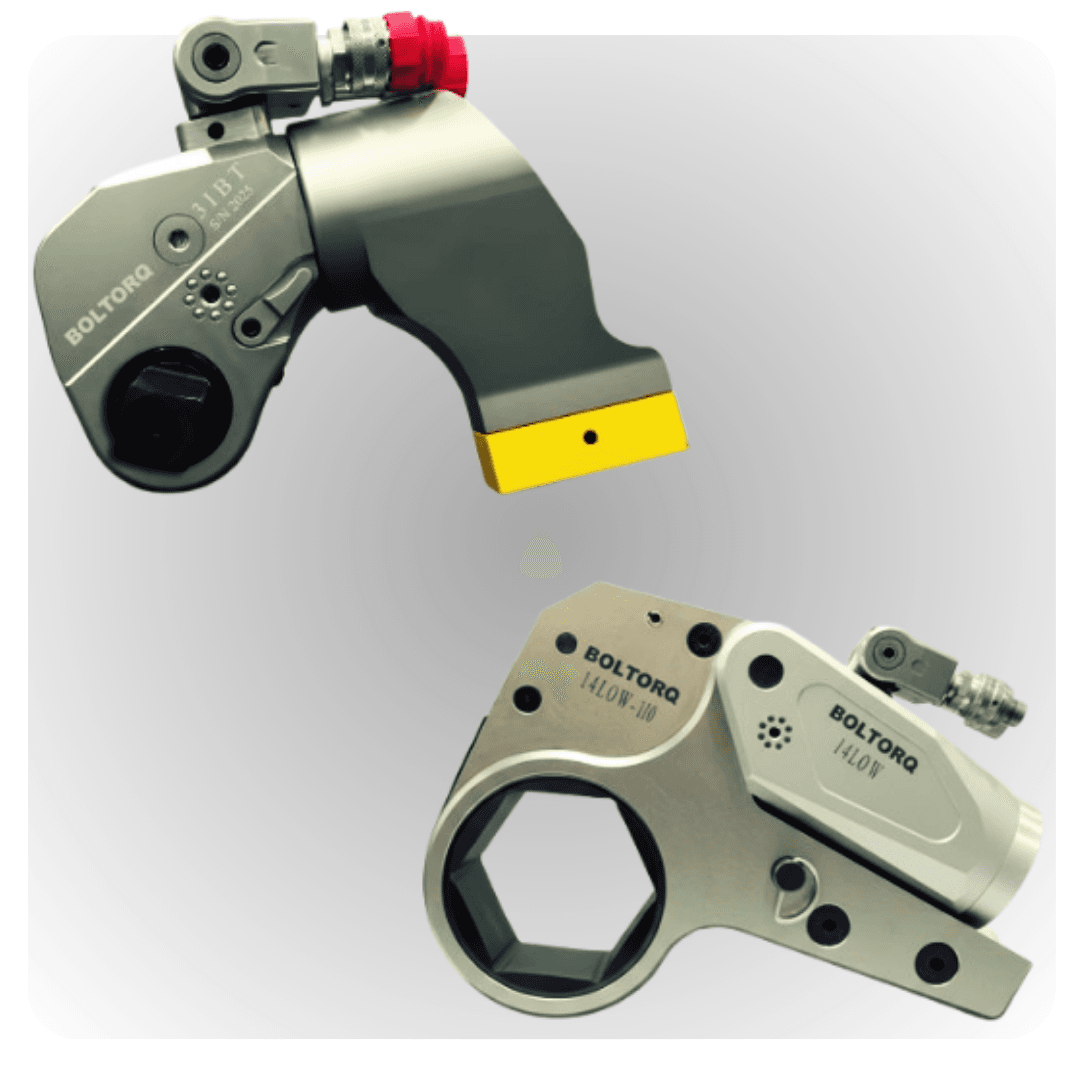
- Preventing Failure: By using a tool like the Boltorq Hydraulic Series, engineers can ensure bolts reach their specific “proof load.” This prevents the bolts from entering the plastic deformation zone, where they would otherwise snap under stress.
3. Power Plant Turbine Maintenance
Steam turbines operate at extreme RPMs and temperatures.
- The Use Case: Casing bolts and rotor couplings.
- Preventing Failure: Hydraulic tools provide a low-profile fit for restricted spaces where a manual wrench cannot reach. Their ±3% accuracy ensures that thermal expansion doesn’t lead to “bolt creep” or vibration-induced loosening.
4. Heavy Equipment & Mining
Mining haul trucks and excavators face relentless pounding.
- The Use Case: Track shoe bolting and rim mounting.
- Preventing Failure: The sheer power of a hydraulic wrench (often exceeding 40,000 Nm) ensures that fasteners stay seated despite extreme shock loads, preventing wheel separations or track failures in the field.
5. Wind Turbine Base & Blade Bolting
Wind towers must sway without breaking.
- The Use Case: Tower segment bolting.
- Preventing Failure: Because hydraulic wrenches are repeatable, they allow for “predictive maintenance.” Technicians can verify that the residual tension is still within safety margins during annual inspections, catching failures before they happen.
Technical Solution: How Hydraulic Precision Saves the Day
To understand why hydraulics reduce breakdown, we must look at the clamping force consistency.
| Problem | Manual/Impact Risk | Hydraulic Solution |
| Galling | High speed causes heat/seizing | Controlled, slow-speed high torque |
| Vibration Loosening | Low/Inconsistent preload | High, uniform clamping force |
| Operator Fatigue | Leads to “short-cutting” | Push-button operation |
| Tool Clearance | Bulky tools can’t fit | Low-Profile or Square Drive options |
Strategic Implementation: Reducing Your Breakdown Rate
To move toward a Zero-Failure bolting strategy, consider the following three-step approach:
- Standardize on Low-Profile Tools: For tight clearances common in oil and gas, use tools like the Low-Profile Hydraulic Torque Wrench to ensure you never have to “skip” a bolt because of access issues.
- Verify Torque-to-Tension: Use hydraulic pumps with calibrated gauges to ensure the pressure ($PSI/Bar$) translates accurately to torque ($Nm/Ft.lbs$).
- Audit the Use Cases: Regularly review your electric torque wrench use cases versus hydraulic needs. While electric is great for speed, hydraulics remain king for pure, raw power and durability in the harshest environments.
Final Verdict
A hydraulic torque wrench is more than a tool; it is insurance against downtime. By ensuring every fastener is tightened to its engineering limit without exceeding it, you protect your equipment, your budget, and your team.
Looking to eliminate bolting failures in your facility? Explore the Boltorq Hydraulic Torque Wrench Range and find the specific solution for your industrial application.

0 Comments