
The Science of Precision: How Does a Torque Wrench Work?
In the world of heavy industry—from wind turbines to oil pipelines—a “tight” bolt isn’t good enough. It has to be precisely tight. At Boltorq, we know that understanding the mechanics behind your tools is the first step toward operational safety and efficiency.
In this guide, we’ll strip back the casing to look at the internal physics, the different mechanical designs, and why the shift toward Electric Torque Wrenches is changing the industrial landscape.
What is Torque? (The Physics of a Bolted Joint)
Before looking at the tool, we must understand the task. Torque is a rotational force applied around a pivot point. In bolting, the goal of torque is actually to create Preload (tension).
When you tighten a nut, you are effectively stretching the bolt like a very stiff spring. This stretch creates a clamping force that holds two surfaces together.
- Under-tighten: The joint can vibrate loose (fatigue failure).
- Over-tighten: The bolt can exceed its “elastic limit” and snap or strip threads.
The fundamental formula for torque is:
T = F x d
(Where T is Torque, F is the Force applied, and d is the Distance from the pivot point.)
Read Also: The Ultimate Guide to Electric Torque Wrenches: Precision Bolting for Modern Industry
How Different Torque Wrenches Work
While every torque wrench serves the same purpose, the internal “trigger” that tells you to stop varies by design.
1. Click-Type Torque Wrenches (The Mechanical Standard)
The most common manual tool. Inside the handle sits a calibrated coil spring pushing against a toggle block (or pawl).
- The Mechanism: As you turn the handle to set the torque, you compress the spring. When the force you apply to the bolt exceeds the pressure of the internal spring, the toggle block “slips” and hits the side of the metal casing.
- The Result: That famous “click” sound and a slight feel of the handle giving way.
2. Beam Torque Wrenches
These rely on Hooke’s Law, which states that the deformation of an object is proportional to the force applied to it.
- The Mechanism: A main lever beam flexes as you pull, while a second “pointer” beam remains stationary.
- The Result: You visually track the pointer against a scale. It is simple and highly durable but prone to parallax error (reading the scale at the wrong angle).
3. Electric & Digital Torque Wrenches

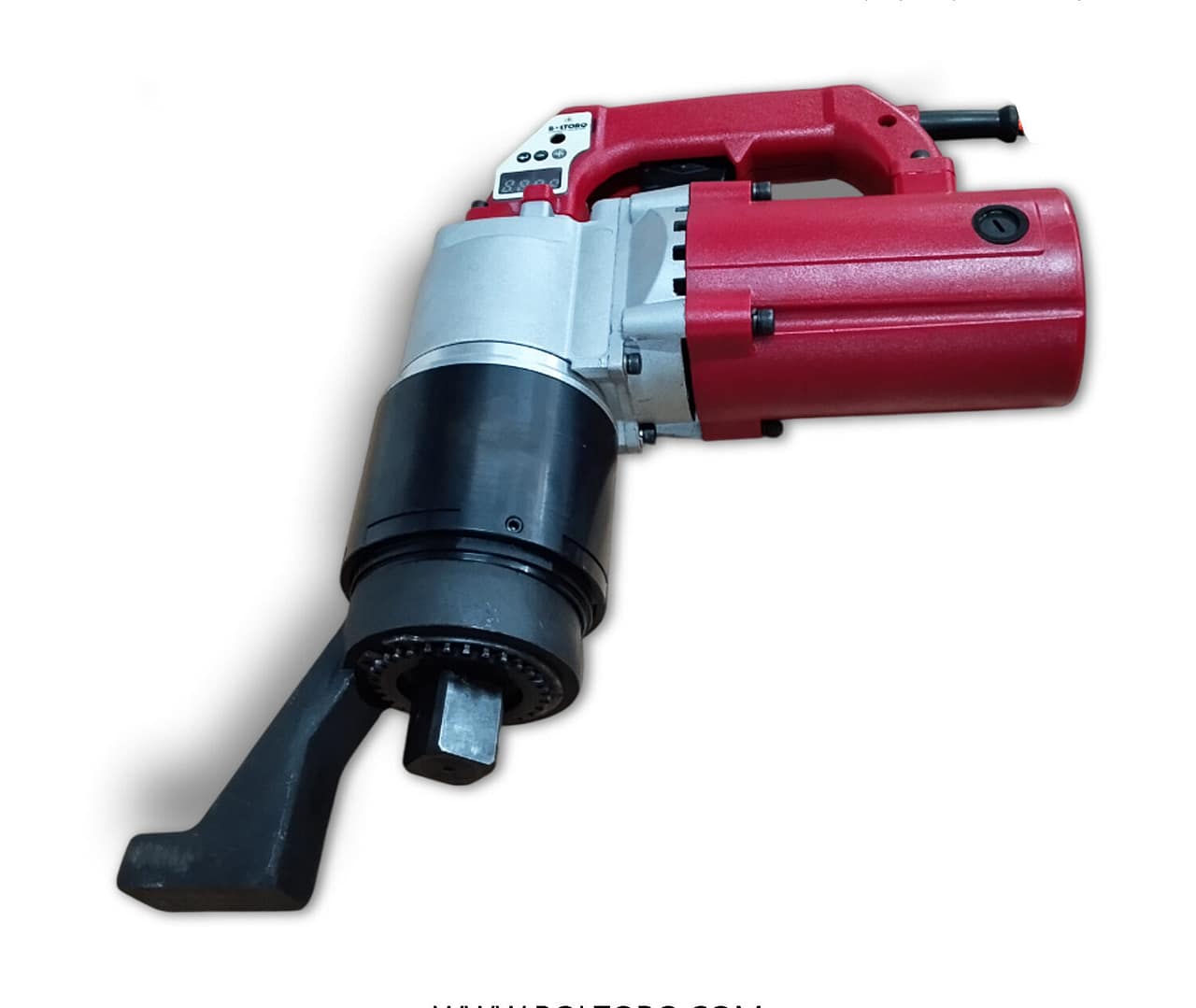
At Boltorq, we specialize in the next evolution: Electric Torque Wrenches. These don’t rely on physical springs.
- The Mechanism: They use Strain Gauges—small sensors attached to the drive shaft. As the shaft experiences torsion (twisting), its electrical resistance changes. A microprocessor converts this change into a precise torque reading.
- The Advantage: Unlike manual tools, electric wrenches use a planetary gear system to multiply motor torque, allowing for massive force (up to 10,000+ Nm) with zero physical effort from the operator.
Why Electric is Outperforming Manual
For industrial-scale projects, the traditional “click” is becoming obsolete. Here’s why:
| Feature | Manual Click Wrench | Boltorq Electric Wrench |
| Accuracy | +-4% to 6% | +-3% or better |
| Speed | Slow, manual reset | Continuous high-speed rotation |
| Data | None (Manual logging) | Digital data logging (Traceability) |
| Safety | High risk of “jerking” injury | Smooth, reaction-arm stabilized |
The Critical Importance of Calibration
A torque wrench is a measuring instrument, not just a wrench. Over time, internal springs fatigue and electronic sensors can drift.
Standard industry practice (ISO 6789) recommends calibration every 5,000 cycles or every 12 months. Using an uncalibrated tool on a high-pressure flange isn’t just a mistake—it’s a major safety liability.
Choosing the Right Tool
Understanding how a torque wrench works helps you choose the right one for the job.
- Use a Beam or Click wrench for light automotive work.
- Use a Boltorq Electric Torque Wrench for structural steel, wind energy, and heavy industrial maintenance where accuracy and speed are non-negotiable.
Need the right tools for your next project?
Whether you need to purchase, rent, or hire a professional team to handle your bolting needs, Boltorq provides the most advanced torque solutions in the industry.

0 Comments