
The Professional Guide to Torque Wrench Precision
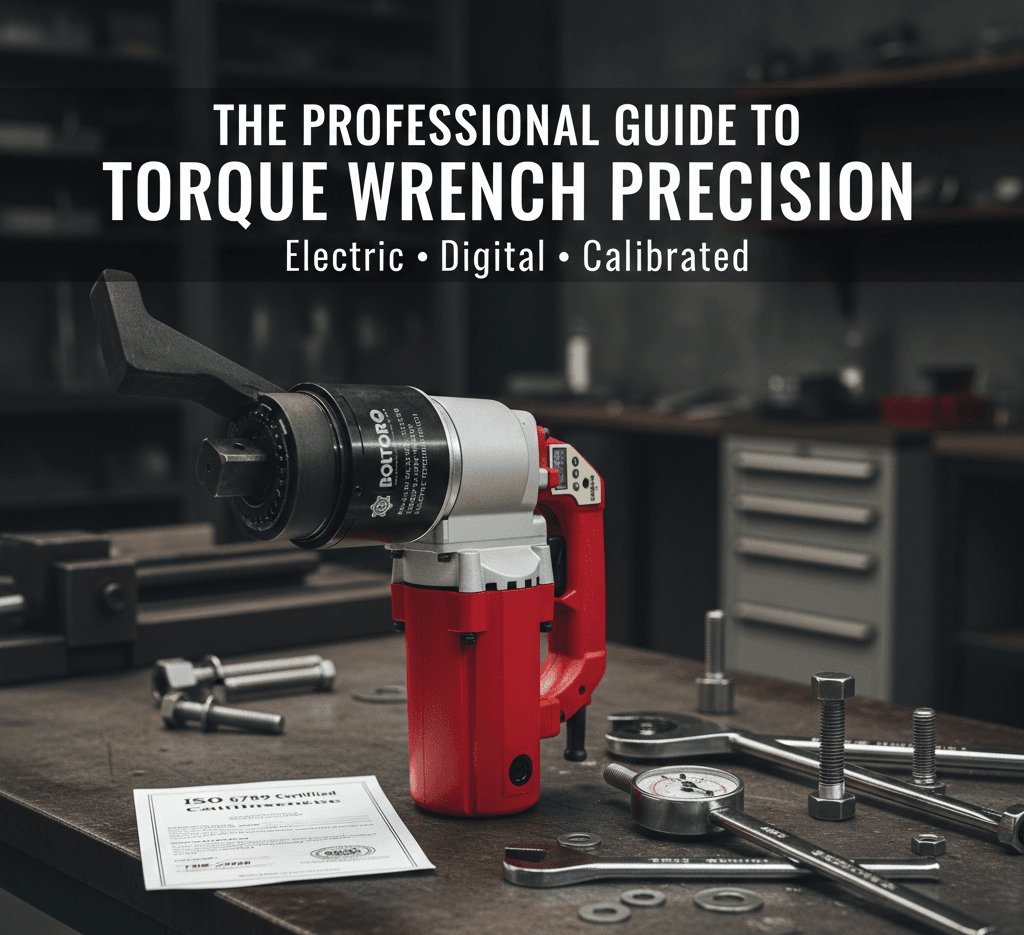
Whether you are working in aerospace, heavy manufacturing, or high-performance automotive engineering, understanding your tools is non-negotiable. A torque wrench is not just a “fancy spanner”—it is a calibrated measuring instrument.
Types of Torque Wrenches
Not all torque applications are created equal. Depending on your industry’s tolerance levels, you’ll likely encounter these four:
- Click-Type: The industry workhorse. You set the value, and the internal spring releases with an audible “click” when reached.
- Beam-Type: Simple, durable, and uses no moving parts. It relies on the visual deflection of a metal beam against a scale.
- Dial-Type: Widely considered one of the most accurate manual versions, used frequently in quality control to verify applied torque.
- Digital/Electric Torque Wrenches: The gold standard for 2026. These provide real-time LED/buzzer feedback and, crucially, data logging for audit trails.
The Golden Rules of Operation
To maintain the integrity of your fasteners (and your tool), follow these professional protocols:
- Steady Pressure Only: Never jerk the wrench. Apply force in one smooth, continuous motion. Jerking causes “inertia overshoot,” where the actual torque exceeds the set limit before the tool can react.
- The 20-100% Rule: Most mechanical wrenches are only certified for accuracy between 20% and 100% of their full scale. If you need 20 Nm, don’t use a wrench that starts at 20 Nm—use a smaller one where 20 Nm falls in the middle of the range.
- The “Zero-Out” Ritual: If you’re using a mechanical click-type wrench, always return it to its lowest setting (never zero, but the lowest marked value) before storage. Leaving the spring under tension will cause it to lose calibration over time.
Calibration: The Silent Killer of Accuracy
A torque wrench that hasn’t been calibrated in a year is just a heavy breaker bar. According to ISO 6789 standards, a professional tool should be calibrated every 5,000 cycles or every 12 months.
Pro Tip: If you drop your wrench on a concrete floor, its calibration is officially void. Get it tested before its next use.
The Shift to Digital: Why Modern Engineering is Changing
In a world of “smart” manufacturing, manual clicking is being replaced by digital precision. Why? Because a digital interface removes the “human feel” variable.
Modern Electric Digital Torque Wrenches offer:
- ±3% Accuracy: Far surpassing the ±4% of traditional clickers.
- Angle Measurement: Critical for “Torque-to-Yield” bolts where a specific degree of turn is required after reaching a base torque.
- Traceability: The ability to export data via USB or Bluetooth to prove that every bolt on a bridge or engine was tightened to spec.
If your project demands zero margin for error, it’s time to put down the manual clicker and upgrade your kit.
Ready to elevate your precision?
Explore the next generation of fastening technology with our high-performance Electric Digital Torque Wrenches. Designed for the most demanding industrial environments where accuracy isn’t just a goal—it’s a requirement.
Check out the full specs here: Boltorq Electric Torque Wrench – Digital Type


0 Comments